


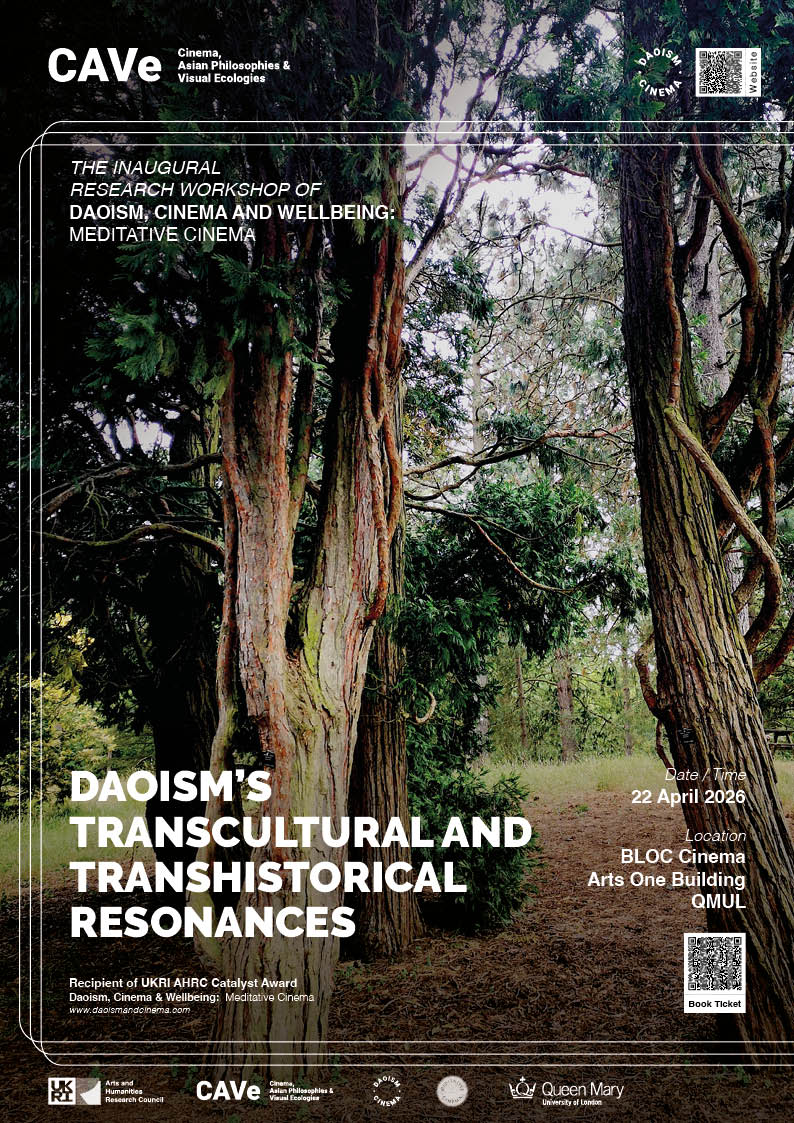
Daoism’s transcultural and transhistorical resonances
Poster
About
The Inaugural Research Workshop of
‘Daoism, Cinema and Wellbeing:
Meditative Cinema’
This first workshop entitled “Daoism’ Transcultural and transhistorical resonances” foregrounds the philosophical and aesthetic connections and exchanges between Daoist thought and broader philosophical traditions across Asia, the West, and beyond. It invites participants, from various disciplines, to examine the historical and contemporary networks through which ideas, artistic practices, and cultural forms circulate, so to rethink film ontology, aesthetics, and ethics as inherently transcultural and transhistorical projects rather than traditions bounded by geography or nation. In doing so, it also invites participants to consider how a renewed, de-Westernised philosophical and theoretical approach can deepen decolonial understandings of ecology and wellbeing, thereby contributing to new forms of cinematic world-making.
We will also address methodological questions central to comparative film philosophy, including how to navigate cultural specificity without falling into essentialism and how to articulate meaningful conceptual bridges across traditions. The discussion further considers the decolonial significance of such an approach, exploring how transcultural frameworks can unsettle entrenched Western paradigms and open space for alternative aesthetic genealogies.
This first workshop also marks the launch of CAVe – Cinema, Asian Philosophes and Visual Ecologies Research Hub in the School of Arts at QMUL.
Schedule
10:00 – 10:30 am
Registration
10:30 – 10:45 am
Introduction
Kiki Tianqi Yu, Principal Investigator of “Daoism, Cinema and Wellbeing” project
Reader in Cinematic Art, Queen Mary University of London
10:45 – 11:40 am
Keynote Speech
David Chai – Associate Professor in Philosophy, the Chinese University of Hong Kong
Do Cinematic Images Exist in the World? A Daoist Response
11:50 – 1:00pm
Panel 1: Intermedial and transhistorical Perspectives – Chaired by Anat Pick
Paul Gladston – UNSW Judith Neilson Chair Professor of Contemporary Art
Dis-/Continuing Traditions: Chinese Contemporary Video Art and the Persistent Traces of Daoism
Kiki Tianqi Yu – Reader in Cinematic Art, Queen Mary University of London
Nothingness as Film (Me)Ontology and Breath as Cinematic Engagement: Heidegger, Irigaray and Daoism
1:00 – 2:00 pm
Lunch for speakers
2:00 – 3:30 pm
Panel 2: Daoism’s Global Resonances – Chaired by David Chai
Rob Stone – Emeritus Professor of Film Studies, University of Birmingham
Adding a Transcendentalist Imperative (breathe in) to Daoist Meditative Practice (breathe out) in American Independent Cinema
Anat Pick – Professor of Film, Queen Mary University of London
A Few Thoughts on Simone Weil’s Daoist Inclinations
Yuehan Liu – Lecturer in Film, Chengdu University of Technology
Forests, Spirits and Tree Burial: Revisiting Daoism and Animism in Japanese Cinema
3:30 – 4:00 pm
Coffee and Tea
4:00 – 5:10 pm
Panel 3: Confucianism- Buddhism-Daoism dialogues – Chaired by Paul Gladston
Victor Fan – Professor of Film and Media Philosophy, King’s College London
Ethics: The Ontologico-Technological Double Bind in Neo-Confucianism
David Fleming – Senior Lecturer in Film Studies, University of Stirling
The Screen Dao of Confucius(es): Regarding the Lives, Deaths, and Afterlife Dialogues of China’s paramount film philosophers
5:10 – 5:50 pm
Roundtable Discussion: doing film philosophy comparatively and decolonial challenges – all speakers
Speaker
David Chai
Chinese University of Hong Kong
David Chai is Associate Professor of Philosophy at the Chinese University of Hong Kong. He is Series Editor of Daoism and the Human Experience (Bloomsbury) and has published widely on topics in ancient and medieval Chinese philosophy, comparative philosophy, and aesthetics.
Paul Gladston
University of New South Wales
Paul Gladston is the inaugural Judith Neilson Chair Professor of Chinese Contemporary Art at the University of New South Wales, Sydney and a distinguished affiliate fellow of the UK-China Humanities Alliance, Tsinghua University. He is co-editor of the academic book series Contemporary East Asian Visual Cultures, Societies and Politics and was founding principal editor of the Journal of Contemporary Chinese Art. His recent publications include the co-edited collections Rethinking Displays of Chinese Contemporary Art: Diversity and Tradition (2024) and Visual Culture Wars at the Borders of Contemporary China (2021) as well as the monographs Contemporary Chinese Art, Aesthetic Modernity and Zhang Peili: Towards a Critical Contemporaneity (2019) and Contemporary Chinese Art: A Critical History (2014), awarded ‘best publication’ at the Awards of Art China (2015). He was an advisor to the internationally acclaimed exhibition ‘Art of Change: New Directions from China’, Hayward Gallery-South Bank Centre, London (2012) and has been a regular contributor to the New York-based magazine Brooklyn Rail’s online ‘New Social Environment’ series. His work as a curator also includes exhibitions in Australia, Taiwan and the UK.
Kiki Tianqi Yu
Queen Mary University of London
Kiki Tianqi Yu is writer, filmmaker and curator. She is Reader in Cinematic Art in the Department of Film Studies at Queen Mary University of London. Her project “Daoism, Cinema and Wellbeing: Meditative Cinema” received AHRC Catalyst Award. Her research explores cinema in relation to Asian philosophies, art histories, personal expression, and decolonisation. She is the author of ‘My’ Self on Camera: First Person Documentary Practice in an Individualising China (2019), and co-editor of China’s iGeneration: Cinema and Moving Image Culture for the 21st Century (2014) and Essay Film and Narrative Techniques(2025).Kiki’s award-winning films, including Memory of Home (2009), China’s Van Goghs (2016), and The Two Lives of Li Ermao (2019), have been widely screened at international film festivals and art institutions. Her curatorial practices include Spirit of Mountains and Water: Cosmological thinking is Gao Shiqiang’s moving image art and Dancing with Water: Women’s Cinema from Contemporary China film season.
Rob Stone
University of Birmingham, UK
Rob Stone is Emeritus Professor of Film Studies at the University of Birmingham. He researches and writes on the dynamics of World Cinema, American independent cinema, and Hispanic cinemas (Basque, Spanish, Cuban) with particular emphasis on the relations between aesthetics, politics, and philosophy. His publications include The Cinema of Richard Linklater: Walk, Don’t Run (Columbia University Press, 2013; 2nd edition 2018) and Lady Bird: Self-Determination for a New Century (Routledge, 2022). He also co-edits The Routledge Companion to World Cinema (Routledge, 2017; 2nd edition 2027) and is a filmmaker and video essayist. His latest monograph is Imagined Life: American Independent Cinema and Transcendentalism which will be published by Edinburgh University Press in 2026.
Anat Pick
Queen Mary University of London
Anat Pick is Professor of Film and the Head of the Department of Film at Queen Mary University of London. She is author of Creaturely Poetics: Animality and Vulnerability in Literature and Film (Columbia University Press, 2011), co-editor of co-editor of Permacinema: Rootedness, Regeneration, Resistance (Palgrave, 2026), Religion in Contemporary Thought and Cinema (Edinburgh University Press, 2019), and Screening Nature: Cinema Beyond the Human (Berghahn, 2013). Anat has published widely on animals, ecology, and film philosophy. Her current book project is entitled Simone Weil and the Cinema of Affliction (Edinburgh University Press, 2027).
Yuehan Liu
Chengdu University of Technology
Yuehan Liu is Lecturer in film and media at Chengdu University of Technology. Liu received her PhD in Film Studies from Queen Mary University of London. Her doctoral thesis, forging a dialogue between film studies and humanistic geography, proposes “place-intimate slow cinema” as a novel critical lens to think about contemporary cinematic slowness and representations of spaces. This concept emerged from her close readings of films that explore human-place relationships and issues concerning gender, ethnicity and ecology. Liu continues to expand her research on slow cinema, East Asian cinema and culture. Her ongoing research focuses on the convergence of slow cinema with feminist film, minority representation, and ecological aesthetics, exploring how marginalized voices and non-human agents expand our understanding of time, space and existence.
Victor Fan
King’s College London
Victor Fan is Professor of Film and Media Philosophy, King’s College London and a film festival consultant. He is also Vice President of the Asian Cinema Studies Society. He is the author of Cinema Approaching Reality: Locating Chinese Film Theory(University of Minnesota Press, 2015), Extraterritoriality: Locating Hong Kong Cinema and Media (Edinburg University Press, 2019), and Cinema Illuminating Reality: Media Philosophy through Buddhism (University of Minnesota Press, 2022). His articles appeared in journals including Camera Obscura, Journal of Chinese Cinemas, Screen, and Film History. His film The Well was an official selection of the São Paolo International Film Festival; it was also screened at the Anthology Film Archives, the Japan Society and the George Eastman House.
David H. Fleming
University of Stirling
David H. Fleming is a Senior Lecturer/Associate Professor at the University of Stirling. His research straddle the theoretical and practical sides of film philosophy, and gravitates around the intersectionalities of Screens, Thinking, and Worlds—the name of the decolonising and defamiliarising Edinburgh University Press book series he is co-founding editor of. His video essays Waking/Examined-After/Lives (2026), Danse Macabre (2025), and Hiber-nation (2024) and are currently open access via [In]Transition and Screenworks. He is the co-author, with William Brown, of Infinite Ontologies of the Chthulustream: Posthumanism and Racial Capital in Contemporary Streaming Media (2025) and The Squid Cinema From Hell (2020). He authored Chinese Urban Shi-nema (2020) with Simon Harrison and is the author of Cinematically Rendering Confucius: Chinese Film Philosophy and the Efficacious Screen-Play (2025) and Unbecoming Cinema (2017).
Abstract
Keynote:
Do Cinematic Images Exist in the World? A Daoist Response
David Chai
Chinese University of Hong Kong
If cinema is irreducibly photographic in nature, grounding its images in human reality and the natural world, does it have being? If we say yes, where does it come from? Supposing it is derived from the beings comprising a film, how is this possible when cinematic images do not exist outside of the temporality of their showing and the spatiality of the film onto which they are imprinted? If the ontology of cinematic images ends when their corresponding subjects die, then films never truly exist in the world and so are being-less. In contrast, sculptures stand in the world and reveal their being in said standing. From the perspective of Daoist philosophy, they do so because of their potential for self-fashioning. As with living things, the being of sculpture lies not in the image(s) of its form but in the intrinsic potential of its raw material to be sculpted and sculpt others via the place created in its self-standing. This is why Daoism holds the natural world is a sculptural collectivity in which each thing’s flourishing and perishing impacts those things around it. To grasp the source of this activity (the Dao) is to have a genuine ontological encounter with the world. How can cinema achieve this?
Panel ONE:
Dis-/Continuing Traditions: Chinese Contemporary Video Art and the Persistent Traces of Daoism
Paul Gladston
University of New South Wales
Daoism’s core envisioning of yin-yang – immanent dynamic cosmological reciprocity – is a major contributing factor to classical Chinese syncretic Daoist/Buddhist inflected neo-Confucian aesthetics. As such, it informs historical ideas and practices specific to Sinophone cultural contexts. These include: qiyun shengdong – vital energy resonance between all things – considered to be the ruling desideratum of Chinese classical painting and poetry; xushi – reciprocal interplay between formal substance and absence; xiuyang – self cultivation; the achievement of neixin – heart/innermost being – in the face of worldly conflicts and suffering; and tian-ren-he-yi – respect for the unity of nature – as well as the possibility of oblique resistances to overweening authority described in the writings of Zhuangzi (3rd century BCE) and exemplified by the Seven Sages of the Bamboo Grove (3rd century BCE). This paper will identify and discursively analyse persistent traces of Daoist/syncretic Confucian aesthetics discernible in relation to contemporary video art by Sinophone artists.
Contemporary Art across the Sinosphere is shaped generally by transcultural intersections between thinking and practice characteristic of defamiliarizing (deconstructive) European/American avant-garde modernist, postmodernist and contemporary art and aspects of localised Chinese culture. Such intersections are part of a longer relay of transculturality between China and Europe/America constitutive of modernity in each of those locations since the 17th century.
It will be shown with reference to recent video art works by the artists Tong Wenmin and Zheng Xinhao that Daoism continues to inform Sinospheric contemporary art as part of a durable Chinese cultural habitus given increased prominence in recent years by official and unofficial institutional assertions of the value of classical Chinese culture. Video works by Tong and Zheng are thus open to parallactic interpretation as enacting disjunctive deconstructivist interventions with supposedly authoritative meaning while also carrying the traces of Daoist aspirations toward unity and harmony. The paper will conclude with a brief critical analysis of the possible significances of this transcultural relationship between deconstructivism and Daoist inflected aesthetics.
Panel ONE:
Nothingness as Film (Me)Ontology and Breath as Cinematic Engagement: Heidegger, Irigaray and Daoism
Kiki Tianqi Yu
Queen Mary University of London
Cinema has long been understood within a European art-historical lineage. Based on Renaissance vantage point perspective, cinema continues the function of painting as a representational object viewed by a human subject, or what Carroll calls ‘detached display’. This tradition, centred on the imitation of reality, informs André Bazin’s influential account of cinematic realism. Underlying the Bazinian preoccupation with realism, rooted in the ‘mummy complex’, lies a Western metaphysical understanding of nonbeing. This differs profoundly from the Daoist conception, which has significantly shaped Chinese aesthetic traditions where art is not grounded in mimesis but in “spiritual resonance.” Rather than reproducing reality, art seeks to attune to the generative rhythms of the Dao.
Early twentieth-century encounters with Chinese and Japanese art played a formative role in reshaping modern Western aesthetics. Exploring Chinese art theories, Laurance Binyon raised the question of “What conceptions of man and nature did they (the Chinese) seek to express? How did they conceive of art itself, and of its function in life?” Roger Fry’s engagement with six canons of Chinese painting, theorised by Xie He in the Sixth century, especially ‘rhythmic vitality’, has deeply influenced his formalist aesthetic theory. However, while modern western art also influenced the then new art of cinema, such transcultural aesthetic connections have been largely underexplored in the studies of film.
This paper proposes a rethinking of cinema through a Daoist (me)ontological cosmology that understands non-being (wu) not as absence but as a generative force. From this perspective, nothingness reconfigures film ontology and enables cinematic potentialities, revealing cinema as a breathing and meditative medium, especially in what I call ‘meditative cinema’. Drawing on my work-in-progress monograph Cinema that Breathes, I suggest that, like the breath-infused gestures of calligraphy, music and embodied performance art, cinema can carry the flow of qi and manifest ‘rhythmic vitality’. Bringing Daoism into dialogue with Martin Heidegger, Luce Irigaray, and film phenomenology, I argue that moving images shape not only what is seen but also invite a mode of engagement through breathing, reconfiguring the relationship between humans and nature.
Panel TWO:
Adding a Transcendentalist Imperative (breathe in) to Daoist Meditative Practice (breathe out) in American Independent Cinema
Rob Stone
University of Birmingham, UK
This 19th century New England group of Transcendentalists led by Ralph Waldo Emerson, Henry David Thoreau, and Margaret Fuller, subscribed to an idealistic philosophy based upon an intuitive and imaginative understanding of the importance of active souls, interconnectedness with divine energy through nature, and the transformation of the knowledge and experience of the individual into self-reliance. Daoism, which reached America in the backwash from the European colonial presence in Asia (Hodder 2010: 28), impacts Transcendentalism “as a corrective to the centuries-long dominion of Christianity in the West” (Hodder 2010: 27) to the extent that Emerson would shock Harvard’s Divinity School in 1838 by proclaiming “Europe has always owed to oriental genius, its divine impulses” ([1838] 2014: 78). Thoreau too “was a confirmed exponent of the perennial wisdom he found illustrated in Asian scriptures” (Hodder 2010: 32) and his efforts at conjoining Transcendentalism with Daoism fed into the creative praxis of working towards an imagined life in ways that he deemed essential to the evolution of individualism and Emersonian perfectionism. In this paper derived from my forthcoming book Imagined Life: American Independent Cinema and Transcendentalism (EUP, 2026), I trace the dialectic of Transcendentalist and Daoist beliefs examined by Emerson and Thoreau and argue that their synthesis is evident in the themes and creative praxes of recent American independent films. Identifying filming and editing strategies that approximate meditative practice, in which films and their audiences breathe in (not without tension) and breathe out (with relief, finding our place in the cosmos), I parse films such as Slacker (Linklater, 1990), Clerks (Smith, 1994), Man Push Cart (Bahrani, 2005), Paterson (Jarmusch, 2016), The Rider (Zhao, 2017), Support The Girls (Bujalski, 2018), Nomadland (Zhao, 2020), Showing Up (Reichardt, 2022) and Train Dreams (Bentley, 2025) in search of a synthesis of Transcendentalist and Daoist beliefs aimed at transcendence.
Panel TWO:
A Few Thoughts on Simone Weil’s Daoist Inclinations
Anat Pick
Queen Mary University of London
What dignity it gives to the afflicted man who is succoured, to know that he can give Christ’s thanks to his benefactor. ὑπομονή [Hypomonē]—water in Taoism—Stoics. (Simone Weil, First and Last Notebooks 84)
Although she is discussed largely in the context of Western philosophy and religion, Simone Weil (1909-1943) was deeply engaged with Eastern philosophies. A reader of classical Indian and Tibetan texts, Weil taught herself Sanskrit and was profoundly influenced by the Bhagavad Gita. The growing interest in Weil’s relationship to Eastern philosophy is evident in publications like Dharma and Detachment: Writings on Indian and Tibetan Thought (2025). Edited by Nicolas Bommarito, the volume is the first to gather in one place Weil’s different commentaries on Indo-Tibetan texts.
While her comments on Daoism are few and far between, several of Weil’s key ideas correspond to themes in Daoist philosophy. Her invocation of non-action, emptiness, self-effacement, and—most important—the idea of attention, parallel the Daoist notion of wu wei (acting without striving). This brief “working paper” examines Weil’s concept of attention as a “negative effort” in relation to both art and to Weil’s provocative understanding of extreme suffering, which she called affliction (malheur). Attention as a mode of detachment and subjective undoing reveals the reality of suffering as something impersonal. In this way, Weil offers a counter-narrative to popular discourses of wellness and wellbeing, a narrative that resonates with, and diverges from, Daoist approaches to suffering. Focusing on my forthcoming book, Simone Weil and the Cinema of Affliction, on the intersection of Weil’s theology and film, I discuss Weil’s bridging between Christian and Eastern approaches in her search for a truly syncretic spirituality.
Panel TWO:
Forests, Spirits and Tree Burial: Revisiting Daoism and Animism in Japanese Cinema
Yuehan Liu
Chengdu University of Technology
Worldviews shape the way we see, know, and understand the world. The modern Western dualism separates subject from object, and human from nature, causing anxiety around existence and mortality. Therefore, revisiting worldviews beyond dominant paradigms is necessary for thinking about our relations with the world.
This paper traces two strands of East Asian thought through cinema: Japanese animism and Daoist philosophy. With roots in ancient Shinto, Buddhist and folk traditions, Japanese animism thinks of the world as full of kami in which spirits residing in trees, mountains, and waters. In this way of thinking, there is no strict boundary between living and dead, and ancestors are able to exist within nature. Daoist thought, with its emphasis on transformation and the continuity of vital energy, also refuses to see death as a rupture. From this view, human existence is situated in the spontaneous flux of the natural world. These ideas are evident in the contemporary practice of tree burial. More than a substitute for conventional graves, tree burial also carries a cultural aspiration to return to and to merge with the nature. In this sense, it resonates with both animist and Daoist thoughts: death as integration into nature’s ongoing cycles.
Through an analysis of Hayao Miyazaki’s animistic forests, and Naomi Kawase’s The Mourning Forest (2007) and Sweet Bean (2015), where trees become sites for mourning and remembering, I argue that contemporary Japanese cinema serves as a critical medium for representing these threads of thought concerning life, death and nature. These films invite us to see that death is not an ending but a form of participation, which shifts focus from the fear of loss to an acceptance of being part of a transforming universe.
Panel THREE:
Ethics: The Ontologico-Technological Double Bind in Neo-Confucianism
Victor Fan
King’s College London
In recent years, many scholars in China and India advocate the use of Hindu, Daoist, Buddhist, and Confucian frameworks to reimagine a more harmonious ecology between sentient beings and the machine, as well as a more ethical notion of algorithmic governmentality. In China, Qian Yi, He Jiankun, and Lu Feng from the Tsinghua University research group on ecocivilization also call for a renewal of Marxism via Daoism and Buddhism to help dismantle the binary opposition between subject and object. Song Bing and his cohorts propose the use of the idea of gongsheng/kosei (inter-becoming) to replace the Marxist notion of dialectic materialism.
However, relational, processual, and ecological understandings of the relationship among sentient beings, technics, and their associated natural and sociopolitical milieu does not guarantee a more holistic and democratic mode of sociality and governmentality. In fact, in the Daoist, Buddhist, and Confucian debates on sociality and governmentality that gradually became what we call neo-Confucianism, ethics is often ambivalently posited both as the ontological ground of a cosmojuridical order and a technology of governance. Such a philosophical double bind have historically produced opportunities for philosophers and those of govern to justify political violence.
In my presentation, I focus specifically on the debate on Zhou Dunyi’s annotations of the Taiji tu shuo [Explanations of the Diagram of the Supreme] among his students Cheng Hao and Cheng Yi as well as the political appropriation of this debate by Zhu Xi and Wang Yangming. I also examine that revisions of this debate by scholars associated with the 1958 “Manifesto on Behalf of Chinese Culture Respectfully Announced to the World” and the more recent scholars who are instrumental in the Communist Party’s policymaking.
Panel THREE
The Screen Dao of Confucius(es): Regarding the Lives, Deaths, and Afterlife Dialogues of China’s paramount film philosophers
David H. Fleming
University of Stirling
Being great, Confucius flows. Or so this paper and accompanying video-essay demonstrate, by remixing historical screen iterations of Confucius in dialogue with other cine-philosophical personae–most notably Laozi–across works including Kǒng Fūzǐ (Fei Mu, 1940), Kǒng Zǐ (Zhang Xinjian and Liu Ziyun, 1991), Kǒng Zǐ (Hu Mei, 2010), Kǒng Zǐ (Han Gang, 2011), Lǎozǐ Chūguān (Chenyun Ma, 2014), Diǎnliàng diǎnzhú de Zhōngguó (2021), and Dāng Mǎkèsī Yùjiàn Kǒngfūzǐ (Li Yuesheng, 2023). As in the famous account of Confucius’s dialogue with Laozi recounted in the Shiji (c. 91 BCE), encounters between China’s two paramount philosophers in these works often serves a pedagogical function: Sketching a contrast between Confucius/Confucianism–associated with ritual order and a humanist moral structure–and Laozi/Daoism–linked to fluidity and cosmological flow. As the 1991 Shandong Television adaptation has Laozi render it: “There is Earth, therefore there is Heaven. There is Yin, therefore there is Yang. There is Laozi, therefore Confucius.”
Drawing on Chinese artistic, philosophical, and screen traditions, this film-philosophical intervention argues that the figure of Confucius embodies a productive tension. Emerging from a Daoist cosmological sensibility oriented toward fluidity and immanence, Confucius’s legacy of ethical cultivation consolidates li as a technology of social stabilization. Cultural notions associated with xiang-thought and mogu-thought can help map the de/reterritorializing pulls between ossifying order and fluid flows. Xiang is historically derived from a pictogram of an elephant skeleton and evokes a mode of dynamic thinking through which image, imagination, and thought operate together, functioning in Chinese intellectual history as a material metaphor for politico-philosophical formation. By contrast mogu emerges out of practices like “boneless” cooking (wu gu) or “boneless art” (mògǔ huà). The audiovisual structure of the video-essay adopts a deliberately fractured form, opening gaps within these artefactual image-imaginings of Confucius onto a virtual Daoist image beyond them.
Report
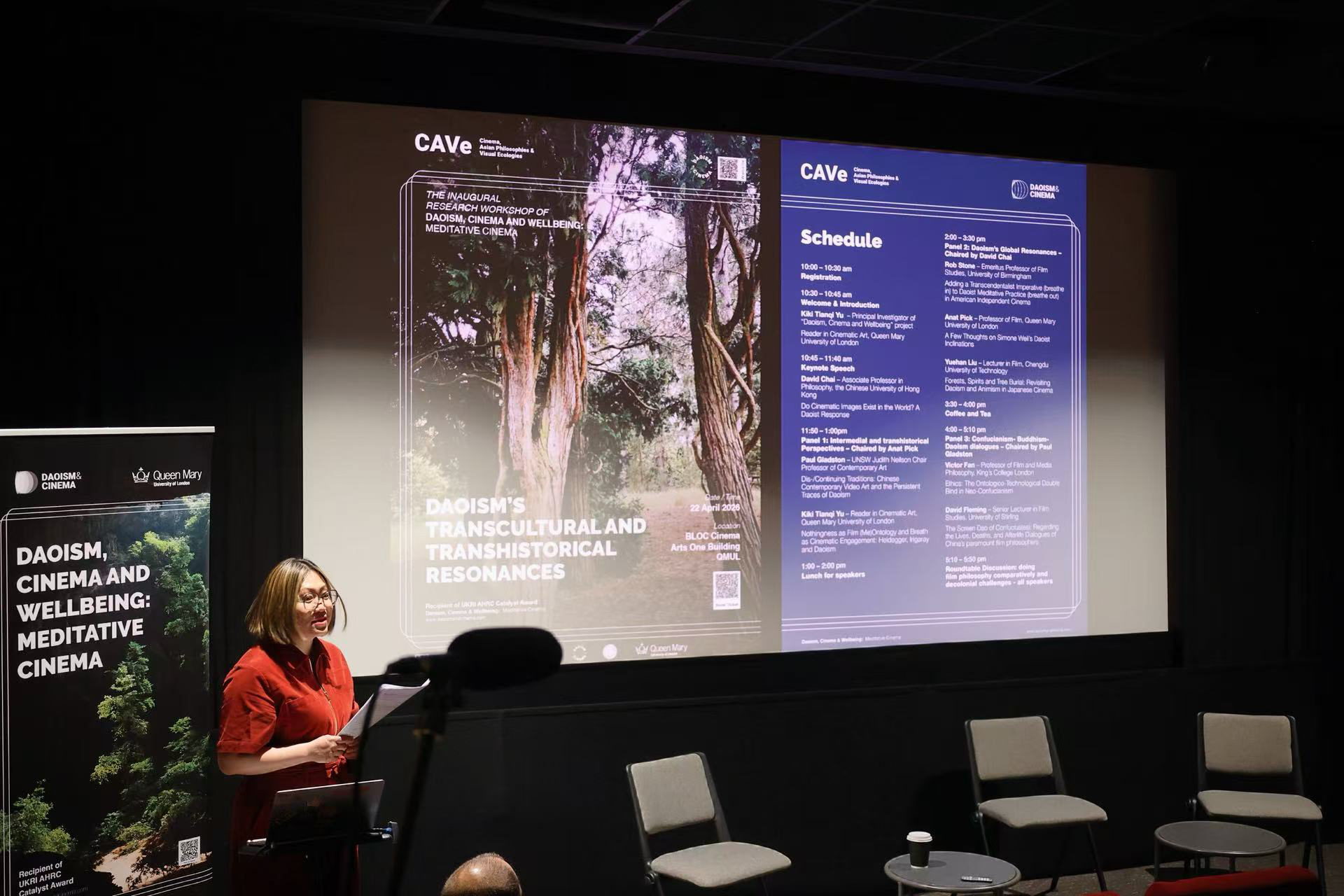
The first research workshop “Daoism’s transcultural and transhistorical resonances’ taken place on 22 April 2026 at BLOC, QMUL was a huge success. Many thanks for eight speakers’s fascinating, honest and detailed exploration through various aspects, as well as excellent questions from the audience. We had such a lively and intensive day, full of rich debates and generous exchanges. Many thanks again to everyone who have contributed to the workshop. We have so much to take away and explore further.
Workshop organsing assistant: Iris Yunke Li
Workshop photo: Chloe Xiaoxin Cheng
Video recording: Wanzhou Xiao and Zhou Guo
Video editing: Zhou Guo


